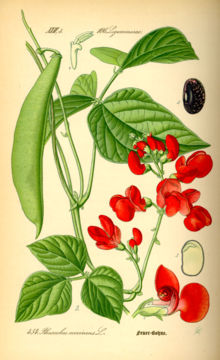
Phaseolus coccineus, known as runner bean, scarlet runner bean, or multiflora bean, is a plant in the Fabaceae family. Runner beans have also been called "Oregon Lima Bean", and in Nahuatl "ayocotl" or in Spanish "ayocote". It differs from the common bean (P. vulgaris) in several respects: the cotyledons stay in the ground during germination, and the plant is a perennial vine with tuberous roots (though it is usually treated as an annual). This species originated from the mountains of Central America. Most varieties have red flowers and multicolored seeds (though some have white flowers and white seeds), and they are often grown as ornamental plants.
The vine can grow to two meters (6 feet) or more in length. The green pods are edible whole before they become fibrous, and the seeds can be used fresh or as dried beans.
The starchy roots are still eaten by Central American Indians. In the UK, the flowers are often ignored, or treated as an attractive bonus to cultivating the plant for the beans, whereas in the US the scarlet runner is widely grown for its attractive flowers by people who would never think of eating it. The flower is known as a favourite of Hummingbirds.
A variety named Judión de la Granja producing large, white, edible beans is cultivated in San Ildefonso, Spain.[5] It is the basis of a Segovian regional dish also named Judiones de la Granja, in which the beans are mixed with pig's ears, pig's trotters and chorizo, amongst other ingredients.[6]
Runner beans contain traces of the poisonous lectin, phytohaemagglutinin, found in common beans.
Phaseolus coccineus subsp. darwinianus is a cultivated subspecies of P. coccineus, it is commonly referred to as the botil bean in Mexico.

No comments:
Post a Comment